PU Concrete Hybrid Flooring: Technical Properties, Composition & Performance Data
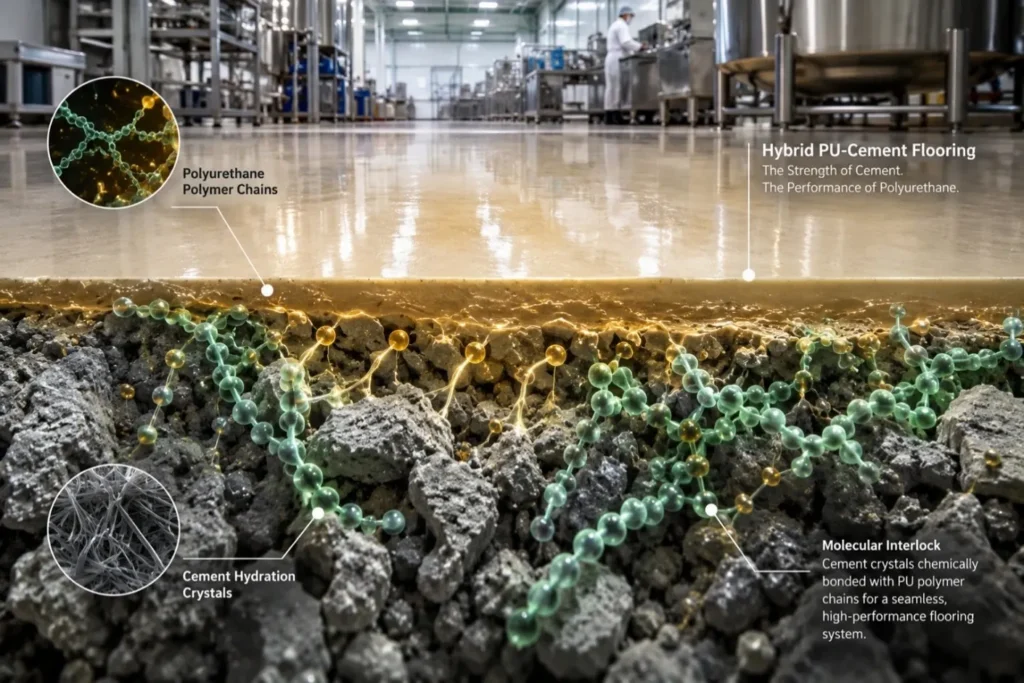
PU concrete (also called polyurethane-cement composite, PUC, or PU cement flooring) is a fluid-applied, cast-in-situ flooring system formed by reacting polyurethane resin with cementitious binder and graded aggregate. It’s specified in facilities where plain concrete and standard epoxy coatings fail under combined thermal, chemical, and mechanical loading like- food and beverage processing, pharmaceutical manufacturing, cold storage, and heavy industrial plants.
System Composition and Chemistry
PU concrete is typically built from three components mixed in controlled ratios:
Polyurethane resin binder
a two-part (or four-component, in heavy-duty systems) reactive system: a polyol component and an isocyanate component that cross-link on mixing to form a semi-rigid elastomeric matrix.
Cementitious filler
Portland cement or specialty cement blends dispersed within the resin matrix, which increases stiffness, reduces material cost, and improves thermal compatibility with the concrete substrate.
Graded aggregate
silica sand or quartz aggregate broadcast or pre-blended into the mix, which increases load-bearing capacity, controls shrinkage, and (in broadcast/quartz systems) contributes slip resistance.
Mechanical Properties of the PU Resin Component
In isolation, the polyurethane binder contributes properties concrete cannot achieve on its own:
- Elastomeric flexibility — PU is a semi-flexible elastomer, giving the finished floor the ability to accommodate minor substrate movement, vibration, and hairline cracking without delaminating or spalling.
- Thermal shock tolerance — PU systems are rated for continuous service across roughly -40°C to 120°C, with some heavy-duty formulations tolerating spillages up to 150°C. Rigid materials (plain concrete, epoxy) develop stress cracking under rapid thermal cycling; PU’s molecular flexibility dissipates that stress instead.
- Chemical resistance — the cross-linked urethane matrix resists organic acids, fats, oils, alkalis, and most industrial solvents, which is why PU is standard in dairy, meat, and bakery plants where lactic acid and animal fat exposure degrade epoxy over time.
- Hardness — Shore D hardness in the 60–85 range depending on formulation, giving abrasion resistance while retaining enough elasticity to avoid brittle failure.
Mechanical Properties of the Concrete/Cementitious Component
The cement and aggregate matrix contribute the structural load-bearing behavior:
- Compressive strength — a standard base concrete slab (102–152 mm thick) typically achieves 28–35 MPa compressive strength. The cementitious filler in the PU system adds bulk stiffness and dimensional stability to the resin matrix rather than relying on resin alone to carry compressive load.
- Tensile strength — plain concrete substrate tensile strength runs only 2–3 MPa, which is the limiting factor in most flooring failures — the coating is rarely what fails first; the base concrete is.
- Rigidity and dimensional stability — the cement/aggregate fraction reduces shrinkage and creep compared to a pure resin system, keeping the floor dimensionally stable under sustained static loads (racking, machinery footings).
- Substrate bonding — a properly prepared (mechanically abraded, laitance-free) concrete substrate is essential, since bond strength between the topping and slab is only as good as the cohesive strength of the concrete itself.
Combined Mechanical Performance of the PU-Concrete Composite
1. Compressive and flexural strength both exceed plain concrete substrate values by a wide margin.
Research on PU-based composites found compressive strength gains of roughly 28–49% and flexural strength gains up to ~11% when moving from PU-cement to PU-mortar to full PU-concrete formulations, driven by aggregate loading and reduced air-void content in the cured matrix.
2. Bond strength consistently exceeds the cohesive strength of the concrete substrate itself.
In practice, the PU concrete topping is rarely the weak link in the system — the underlying slab typically fails before the topping delaminates, provided surface preparation was correct.
3. The composite retains PU's thermal and chemical resistance while gaining concrete-like rigidity.
Neither pure resin nor plain concrete individually delivers both high compressive/flexural strength AND resistance to thermal shock and aggressive chemicals — the hybrid does.
Application Layer Systems
PU concrete is specified by system type based on required thickness and duty class:
- Self-smoothing/screed systems (2–4 mm) — light-to-medium duty, used in workshops, light manufacturing, retail.
- Trowel-applied mortar systems (4–9 mm) — medium-to-heavy duty, common in food processing and pharma cleanrooms.
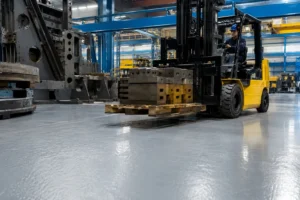
- Heavy-duty broadcast/trowelled systems (9–12 mm) — heavy industrial, cold storage, high-impact zones with forklift and pallet-truck traffic.
Cure schedules are temperature-dependent: light-traffic readiness can be as fast as 12 hours at 30°C substrate temperature versus 36 hours at 10°C, with full chemical cure (solvent/chemical resistance fully developed) taking 6–12 days.
How does PU-cement handle thermal shock better than epoxy?
PU-cement handles thermal shock significantly better than epoxy due to its elastic nature and its ability to expand and contract at a rate similar to the underlying concrete substrate.
1. Modulus of Elasticity and Flexibility
While epoxy is hard, rigid, and brittle, cured polyurethane is tougher and more elastic. This inherent flexibility allows the PU-cement system to flex slightly with the concrete slab and absorb the energy from sudden temperature changes rather than shattering. Epoxy, being “glassy” and rigid, lacks this elasticity and is prone to cracking or debonding when exposed to rapid thermal cycling.
2. Matching Thermal Expansion
A critical technical advantage of PU-cement is its low coefficient of thermal expansion, which is much closer to that of Portland cement-based concrete than that of epoxy systems.
- Uniform Movement: Because the PU-cement expands and contracts at a rate very similar to the concrete floor, it behaves as an integral part of the substrate.
- Reduced Stress: This similarity prevents the build-up of stress at the bond line that typically occurs with epoxy, which expands at a different rate than concrete, leading to delamination or “popping” off the surface during temperature swings.
3. Energy Dispersion and Temperature Range
PU-cement is specifically engineered to handle extreme environments where floors are subjected to both high-heat and sub-zero temperatures:
- Temperature Tolerance: Heavy-duty PU-cement systems can withstand temperatures ranging from -40°C to over 120°C.
- Heat Dispersion: The material’s physical nature makes it superior at dispersing sudden changes in surface temperature, such as when boiling water or steam is used during a wash-down in a cold room.
- Specific Applications: This resilience makes it the standard choice for industries like breweries (boiling wort), dairies (hot water wash-downs), and cold storage facilities (freezer cycling), where epoxy would likely fail.
Summary
| Material / System |
Contributes |
Limitation Alone |
| Polyurethane Resin |
Flexibility, thermal shock resistance, chemical resistance, and fast cure
|
Lower structural rigidity and higher material cost at scale
|
| Concrete / Cement Matrix |
Compressive strength, dimensional stability, and cost-effective bulk
|
Brittle, low tensile strength, porous, and poor chemical resistance
|
| PU-Concrete Composite |
40–60 MPa compressive strength, 15–41.5 MPa flexural strength,
-40°C to 150°C service range, seamless and non-porous surface,
with bond strength exceeding substrate cohesion
|
Higher upfront installation cost than plain concrete or basic coatings
|
Conclusion
Polyurethane (PU) cement flooring is a high-performance hybrid system that merges the structural hardness of cement with the chemical resilience and flexibility of polyurethane resin. This seamless surface is specifically engineered to endure thermal shock, heavy impact, and aggressive chemical exposure in demanding settings like food processing plants and pharmaceutical labs.
When durability, hygiene, thermal shock resistance, and long-term performance are essential, Floorkrete’s FloorCEM® PU Concrete Flooring Systems provide a dependable solution for demanding industrial environments. Whether your facility requires a thin refurbishment coating or a heavy-duty screed capable of withstanding extreme temperatures from below -40°C to +130°C, Floorkrete offers a purpose-built PU concrete system for every application.
The FloorCEM® range includes:
- FloorCEM PUC-912 – 3–6 mm heavy-duty screed for temperatures from below -40°C to +130°C.
- FloorCEM PUC-69 – 6–9 mm screed designed for below -15°C to +90°C service conditions.
- FloorCEM PUC36 – 3–6 mm screed suitable for below -5°C to +80°C environments.
- FloorCEM PUC-13 – 1–3 mm PU-modified hybrid screed for medium-duty applications, offering resistance to temperatures from below 0°C to +80°C.
- FloorCEM PUC-051 – 0.5–1 mm thin screed/coating for refurbishment of existing PU concrete floors and applications with moderate mechanical and chemical exposure, withstanding temperatures up to 70°C.
FAQ