Polyurethane Flooring: Why It Is Ideal for Demanding Industrial Environments
Unlike ordinary floor coatings that primarily provide a protective surface film, a properly designed polyurethane flooring system can function as a high-performance wearing surface with controlled elasticity, impact resistance, thermal stability, and chemical resistance.
The performance of polyurethane flooring does not come from polyurethane resin alone. Its behavior is determined by resin chemistry, crosslink density, aggregate selection, thickness, substrate condition, environmental exposure, and the relationship between the floor system and the concrete substrate beneath it.
What Is Polyurethane Flooring?
Polyurethane chemistry is based on polymer chains containing urethane linkages. The formulation can be modified to achieve specific combinations of hardness, elasticity, abrasion resistance, chemical resistance, impact absorption, and thermal performance.
A major technical advantage of polyurethane flooring is its ability to balance hardness with controlled flexibility. A completely rigid surface can perform well under static loading but may become vulnerable when subjected to substrate movement, impact, vibration, or thermal expansion and contraction. Polyurethane systems can accommodate a degree of movement without behaving as a brittle surface.
The Chemistry Behind Polyurethane Flooring Performance
Polyurethane systems are generally produced through reactions involving polyols and isocyanate-based components. The resulting polymer contains urethane groups that contribute to the mechanical and chemical characteristics of the cured material.
By modifying the chemistry, manufacturers can control properties such as:
- Elasticity and elongation
- Hardness
- Tensile strength
- Abrasion resistance
- Impact resistance
- Chemical resistance
- Moisture tolerance
- Thermal stability
- Adhesion
- Surface finish
The formulation may also contain mineral aggregates, pigments, fillers, additives, catalysts, and other performance-enhancing components.
Mechanical Properties of Polyurethane Flooring
Strength and Load-Bearing Performance
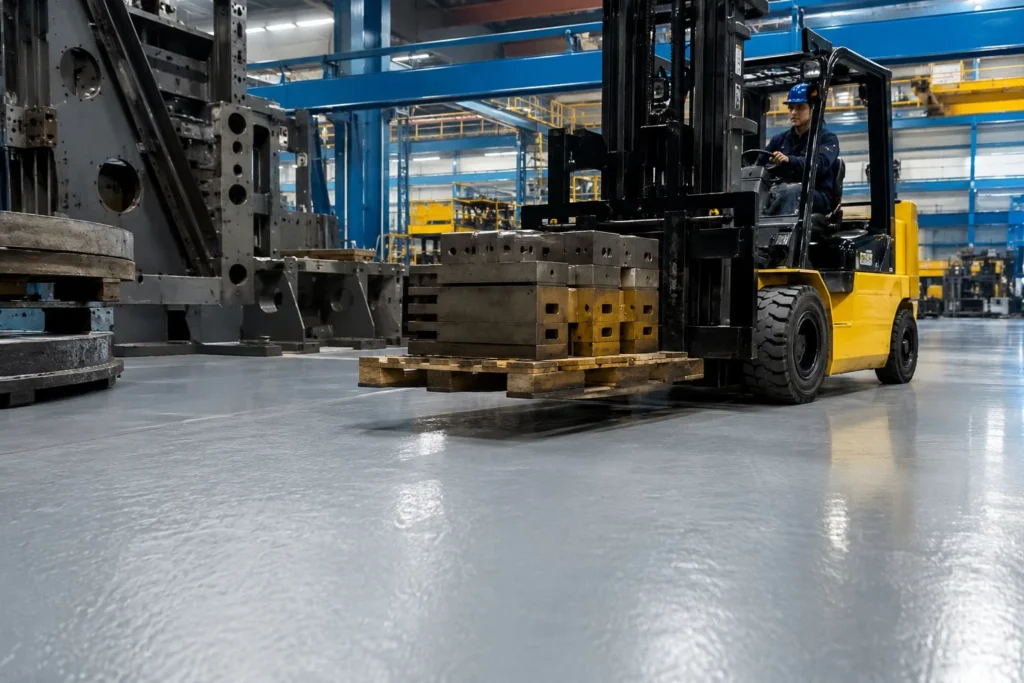
Industrial floors experience static, dynamic, and impact loads. Static loads occur beneath machinery, storage racks, tanks, and production equipment, while dynamic loads result from forklifts, pallet trucks, carts, and industrial vehicles. Impact loads can occur when tools, components, or equipment are dropped.
Polyurethane flooring can withstand these conditions through a combination of compressive strength, tensile properties, toughness, adhesion, and controlled flexibility. However, compressive strength alone does not define flooring performance. Point loads, wheel loads, impact energy, traffic frequency, and adhesion to the concrete substrate must also be considered when selecting an industrial flooring system.
Abrasion Resistance and Industrial Traffic
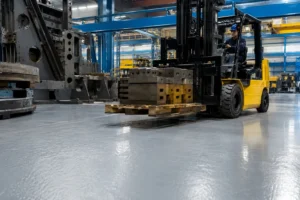
Repeated movement of forklifts, pallet trucks, industrial vehicles, equipment, and abrasive particles can gradually wear a floor surface. Polyurethane flooring can provide high abrasion resistance when formulated for heavy-duty traffic, helping maintain surface integrity under continuous mechanical wear.
Abrasion resistance also affects maintenance and hygiene. Excessive wear can expose underlying layers, generate dust, increase maintenance requirements, and reduce the protective performance of the flooring system. The expected traffic pattern should therefore be considered when specifying a PU flooring system.
Impact Resistance and Toughness
Hardness and toughness represent different performance characteristics. Hardness relates to resistance against indentation, while toughness describes a material’s ability to absorb energy without catastrophic failure.
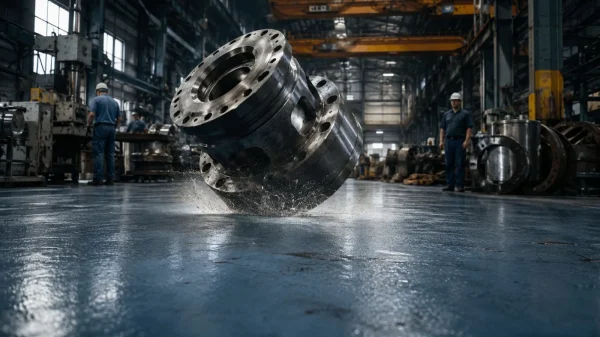
Polyurethane flooring can provide a useful combination of hardness and toughness. Its polymer structure can absorb impact energy more effectively than highly rigid and brittle surfaces, making it suitable for workshops, engineering facilities, manufacturing plants, loading areas, and maintenance zones where components or tools may be dropped.
Thermal Shock Resistance
Industrial floors may experience hot-water cleaning, steam cleaning, refrigeration, cold-storage conditions, heated manufacturing processes, or repeated hot-to-cold cycles.
Rapid temperature changes create stresses because the flooring system and concrete substrate respond differently to thermal movement. Specialized polyurethane cementitious systems can provide improved resistance to these conditions because of their formulation and physical structure.
Chemical Resistance of Polyurethane Flooring
Industrial flooring can come into contact with oils, lubricants, detergents, acids, alkalis, solvents, disinfectants, and process chemicals. Polyurethane flooring can provide strong resistance to many chemical exposures, but chemical resistance should not be considered universal across all PU systems.
Performance depends on chemical concentration, temperature, exposure duration, frequency, resin formulation, and flooring thickness. A short accidental spill is very different from continuous immersion or repeated exposure. Chemical compatibility should therefore be assessed according to the actual substances used in the facility.
Flexibility and Crack-Bridging Capability
Concrete can shrink, expand, vibrate, and develop small cracks during its service life. A flooring system with controlled elasticity can accommodate certain levels of movement more effectively than an extremely rigid coating.
Polyurethane flooring is therefore often selected where flexibility and crack-bridging performance are important. However, it should not be considered a solution for major structural movement or unstable concrete.
Seamless Surface and Hygienic Performance
Conventional flooring can contain joints and grout lines where dirt, liquids, and contaminants accumulate. A seamless polyurethane floor minimizes these discontinuities and can create a continuous surface that is easier to clean and maintain.
This characteristic is valuable in food processing, beverage production, pharmaceutical facilities, laboratories, commercial kitchens, and other hygiene-sensitive environments. Hygienic performance also depends on surface texture, drainage, joint detailing, cleaning procedures, and overall floor design.
Slip Resistance and Surface Texture
A completely smooth floor is not necessarily the safest option, particularly in areas exposed to water, oils, grease, chemicals, or cleaning solutions. Polyurethane flooring can incorporate controlled surface texture to improve traction and reduce slip risk.
However, surface texture must be balanced with cleanability. Excessively aggressive textures may retain contaminants and make cleaning more difficult. The appropriate finish should therefore consider coefficient of friction, contamination, cleaning requirements, pedestrian traffic, and operating conditions.
UV Resistance and Colour Stability
Standard polyurethane flooring is not necessarily designed for continuous outdoor UV exposure. Prolonged ultraviolet radiation can cause discoloration and surface degradation depending on the formulation.
For exposed floors, ramps, terraces, platforms, and outdoor industrial areas, UV stability should be considered separately from chemical and mechanical resistance. Specialized UV-resistant polyurethane systems or compatible protective topcoats can improve weathering performance where required.
Polyurethane Cementitious Flooring
Polyurethane cementitious flooring is one of the most robust categories of resin flooring for severe industrial environments. It combines polyurethane chemistry with cementitious and mineral components to produce a dense and highly filled flooring matrix.
These systems can provide a combination of mechanical strength, impact resistance, abrasion resistance, thermal shock resistance, chemical resistance, and moisture tolerance. They are particularly valuable where several demanding conditions occur simultaneously, such as in food-processing facilities exposed to hot-water cleaning, chemicals, moisture, heavy traffic, and impact.
Key Technical Parameters to Evaluate
| Performance Parameter | Why It Matters |
|---|
| Compressive strength | Resistance to concentrated and static loads |
| Tensile strength | Resistance to tensile stresses |
| Elongation | Indicates deformation capacity |
| Abrasion resistance | Resistance to repeated mechanical wear |
| Impact resistance | Performance under sudden impact |
| Chemical resistance | Compatibility with process chemicals |
| Thermal shock resistance | Performance under rapid temperature changes |
| Adhesion strength | Bond performance with concrete |
| Slip resistance | Pedestrian safety |
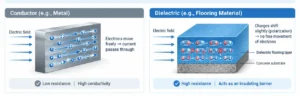
| Electrical resistance | ESD and conductive applications |
| UV resistance | Outdoor weathering performance |
| Hardness | Surface durability and indentation resistance |
These parameters should be assessed collectively because flooring failure often occurs when one important performance characteristic is overlooked.
Common Performance Failure Factors
Even high-performance polyurethane flooring can fail when the system does not match the substrate or operating environment. Common factors include incorrect system selection, excessive substrate moisture, poor concrete quality, contamination, inadequate thickness, uncontrolled structural movement, incompatible chemicals, improper joint treatment, and exposure beyond the manufacturer’s specified limits.
This demonstrates why technical flooring design is as important as the resin chemistry itself.
Conclusion
Polyurethane flooring stands out as a high-performance solution when mechanical durability is the primary requirement. Its combination of high compressive strength, abrasion resistance, impact resistance, toughness, and controlled flexibility enables it to withstand the demanding conditions found in industrial environments.
With Floorkrete’s Floorthane range, flooring systems can be selected to meet different levels of mechanical performance and industrial service requirements. These solutions are designed to provide a durable, robust wearing surface where long-term resistance to mechanical loading and surface wear is essential. Whether the requirement is for heavy-duty industrial flooring, manufacturing facilities, engineering areas, warehouses, or high-traffic zones, the right polyurethane flooring system can contribute to longer service life and reduced floor maintenance.
FloorThane Product range:
- Aquathane 5521
2-Component water-borne polyurethane floor and wall coating for concrete and metal surfaces. - Floorthane 100 (5501)
3-component, solvent-free polyurethane topping for durable and heavy-duty floor protection. - Floorthane 5503
2-component, self-smoothing polyurethane topping for seamless and durable floor surfaces. - Floorthane 5506
2-component, self-smoothing polyurethane coating/topping designed for durable and protective flooring applications.
FAQ